Contents
January 2025 • Vol. 2, Nr. 1
Editorial Dept.
Annie Mydla
Sol Iacob
Cover
Elissa Fox
Annie Mydla
Quote of the Month
Daughter Letter
Daughter Letter #3: To Mom by Stacey Plate
Daughter Letter #3: To Mom by Stacey Plate
Autism Chrysalis Life Coaching
Why are things more annoying in autistic self-discovery? by Heather Cook
Why are things more annoying in autistic self-discovery? by Heather Cook
AuDHD Women Life Coaching
What you need to know about autistic burnout and how to recover from it by Mary Pasciak
What you need to know about autistic burnout and how to recover from it by Mary Pasciak
Essay
The Existential Mug and Other Struggles with Change by Andrea
The Existential Mug and Other Struggles with Change by Andrea
Essay
Ecuador Stories #4: Hungry for Cheeseburgers and the Fern Gully Experience by
Stevie Lou Díaz
Stevie Lou Díaz
Poem
Poem
My Little Bird by Alice Krin
Poem
Falling In Love With Winter by Christina Davidson
Falling In Love With Winter by Christina Davidson
Song
Little Island by Mia B
Comics
Bathrobe Gal: "Do Your Best!" by Sarah Jane Cody
Sticker
About Autistic Women's Group
Established 2021
AWG is an online support group for late-identified autistic women and all other members of marginalized genders.
The meeting format is designed to reduce the sensory, social, and executive function burdens that normally come with socializing. Our members are clinically-diagnosed, self-diagnosed, and questioning. AWG is volunteer-led and not associated with any other umbrella organization or company.
Please consider joining us on Zoom. Our member profile is inclusive. Meetings are always free and no registration is required. Members share by speaking or typing. We have many members who come just to listen. You never have to turn on you mic or camera if you don't want to. You don't have to come to every meeting, or stay the whole meeting, in order to be a full member. Disclosure of diagnosis/gender identity is welcome but never required for participation.
Click her to learn more about attending a meeting. You can also...
- See upcoming meeting topics
- Sign up for meeting reminders (scroll the homepage to find the signup form)
- Join the AWG subreddit for weekly meeting reminders
- Join our sibling meetings: the AWG Self-Esteem Group, Book Club and Connecting Hour, and Discord server
I hope you enjoy AWG Shares Magazine. And please do join us in a meeting sometime if you can.
Annie Mydla
Founder and facilitator, AWG
Quote of the month
Quotes relating to autism and AWG values by autistic and non-autistic people. Have a quote you'd like to share? Send it for inclusion!
“I have, throughout my private war, been a she, a you, a Donna, a me, and finally, an I… If you sense distance, you're not mistaken; it’s real. Welcome to my world.”
Daughter Letter #3: To Mom
Stacey Plate
This piece is part of The Daughter Letters—a series of love letters written from the perspectives of mother, daughter, divine child, and divine mother.
Dear Mom,
Can you imagine what it would have been like, if we’d had mothers who wanted us?
To have been born into the arms of mothers wild enough to greet us—full to the brim with herself, and ready with all the love we’d ever need? To have had mothers big enough to hold all of us, pushing nothing out because there was nothing in us she feared?
Mothers who could have taught and guided us—whose love we would have learned as our own? Who didn’t Alinch from our rage, but met us, stance Airm, channeling her rage back into the earth? Who recognized our magic and celebrated it, with no need to make any bit of it hers?
Can you even imagine?
I can.
What I imagine is everything I long for. And what I long for is everything I needed and never received.
I know you did all you could as my mother and gave me all you had.
It wasn’t enough. You never had enough to begin with. I know that now too.
I don’t know if I’ve fully loved you, either. Not for a very long time. Can you love someone you’ve never really met—someone who has kept herself hidden behind defenses and guards?
Can someone be truly loved who’s never let herself be seen?
For most of my life, I wished things could be different between us. I wanted your love so badly; I gave up so much of myself for the hope of getting it.
I am not leaving myself anymore.
Giving up the hope of your love was a death I grieved, but I wasn’t left barren in its wake.
My own love grew into the gaps. I have let myself be seen. There are others who love me now. I am loved, and it is enough.
I still wish things could be different between us—but the shape of my wish has changed. It asks: Can I love you, even while you don’t love me?
I don’t know but I want to try. I think it would be healing.
I want to love you, Mom, just as you are, even as I protect myself from you. I want to love you, knowing how unsafe you can be. I want to love you without needing to erase a single bit of you, even the parts of you who try to erase me.
When I can do that—give to you what wasn’t here for me—I will have my birthright back.
My love: whole, unfettered and free.
I want to love you, Mom, but how?
I have loved my own daughter every day of her life. She expands my love beyond what you or I could have imagined, Mom. My love for my daughter is deep and vast, a universe unto itself. It holds darkness and light, and doesn’t shy away from any part of her.
Maybe it’s a love that could hold you too.
I wish you knew this feeling, Mom. What it’s like to love yourself, and then your daughter— even more than that. I wish you’d gotten to love me the way I will someday love you. It will be glorious, and I’ll be so happy not to have missed it.
Maybe my loving you will mean you didn’t miss it either. That, I want to imagine.
My love,
Your Daughter
Video: Why are things more annoying in autistic self-discovery?
Heather Cook, Autism Chrysalis Life Coaching
As you figure yourself out more and more,
many people start noticing more things that annoy or bother them.
Here's what's going on, and three ways to deal with it.
You can read a full transcript of the video on the Autism Chrysalis website.
Visit Autism Chrysalis and follow Heather on social media:
Website: www.autismchrysalis.com
YouTube: https://www.youtube.com/@autismchrysalis
X/Twitter: https://twitter.com/hmm_cook
Mastodon: https://universeodon.com/@hmm_cook
Instagram: https://www.instagram.com/autism_chrysalis
BlueSky: https://bsky.app/profile/autismchrysalis.bsky.social
YouTube: https://www.youtube.com/@autismchrysalis
X/Twitter: https://twitter.com/hmm_cook
Mastodon: https://universeodon.com/@hmm_cook
Instagram: https://www.instagram.com/autism_chrysalis
BlueSky: https://bsky.app/profile/autismchrysalis.bsky.social
Article: What you need to know about autistic burnout and how to recover from it
Mary Pasciak, AuDHD Women Life Coaching for women and non-cis genders
As a coach for neurodivergent women and non-cis people, the most profound work I do is helping clients navigate autistic burnout.
About one in three of my clients is in some stage of autistic burnout, with many of them unable to work for a year or more.
Many of us don't even know what autistic burnout is. That means we can't recognize it approaching, can't prevent it, and take longer to recover once we're in it.
The good news is that once you understand autistic burnout, you can redesign your life to expedite recovery and prevent it from happening again.
What autistic burnout isThere are three primary features:
1. Extreme sensory sensitivity. Your already-sensitive nervous system becomes hypersensitive. Bright lights or loud noises feel physically painful.
One of my clients was at Costco – wearing her sunglasses inside – and the bright lights, crowds, and noise were so overwhelming that she started physically shaking.
2. Chronic exhaustion. You feel physically, mentally, and emotionally depleted all the time. No amount of rest helps. Even showering or making a sandwich feels overwhelming.
Another woman couldn't leave her couch for weeks, not even to spend time with her kids.
3. Loss of skills. Executive function declines. Brain fog, memory impairment, and sometimes loss of speech. This is especially alarming when you don't understand it's burnout-related, and you fear you'll never regain those skills.
The causes
Think of your capacity as a bucket. And think of the demands placed on you as the water that’s coming out of a faucet, filling your bucket.
Ideally, your capacity equals or surpasses the demands placed on you.
In autistic burnout, though, the faucet is absolutely gushing water, and your capacity bucket is constantly overflowing.
For autistic people, our everyday demands are greater than they are for most people: sensory input, social interaction, transitions, and masking all drain our energy. Many of us mask constantly, so even "doing nothing" is exhausting.
Without enough rest, alone time, and self-care, your capacity bucket is perpetually overflowing. That's autistic burnout.
How it differs from depression
Autistic burnout can look like major depression but treating it as if it were depression makes it worse.
When someone is depressed, they tend to isolate. So as part of recovery from depression, they’re often encouraged to spend more time with people, get out of the house, and participate in activities as much as they can.
But when you’re in autistic burnout, your central nervous system needs as little sensory input as possible. Increasing your sensory input, your socialization, and your participation in activities will almost certainly exacerbate your burnout, not heal it.
The path to recovery
Too often, people recover from autistic burnout only to return to the exact life that caused it, creating a burnout → recovery → burnout cycle.
Many of us have spent decades living how we think we "should" live. We've masked so long that we've lost sight of who we truly are and what we need.
I help women and non-cis individuals build lasting recovery by redesigning their lives to align with who they truly are. This involves becoming aware of what gives you energy vs. what drains it:
- What lighting feels best
- Who you feel safe unmasking around
- When your energy is highest
- How much transition time you need
- What work aligns with your values
At its core, this work involves undoing lifelong invalidation and reconnecting with your body's signals: what feels safe vs. painful, what to gravitate toward vs. avoid.
You've been nudged toward burnout your entire life — every time someone told you you're "too sensitive," pushed you to "just do the thing" when you lacked capacity, or encouraged you to be who they wanted.
The way out of burnout is through listening to your own voice. I help women give themselves permission to trust their inner voice and learn to honor its truth.
Next month, I'll share specific changes my clients have made to recover from burnout and stay out of it.
If you'd like help recovering from autistic burnout or redesigning your life to align with your needs and values, you can visit www.AuDHDwomen.com to schedule a free consultation. This service is for women and all members of non-cis genders (FTM/MTF trans, nonbinary, genderfluid, autigender, and more).
Want to promote your business, product, or service in AWG Shares? You can!
Promotions are free for everyone who fits our member profile.
Your business doesn't specifically have to be about autism,
but must be welcoming to women and non-cis people
(FTM/MTF trans, nonbinary, genderfluid, autigender, and more).
Email awg@autisticwomensgroup.com or use the submissions form and we'll set up your promotion for the closest upcoming issue.
Essay: The Existential Mug and Other Struggles with Change
Orlando, I think you suffer from a strange melancholy. Which is, you suffer in advance. Look at me. Look. You are too serious, Orlando. And yet not serious enough.
– Orlando (movie), 1992
I had a mug as a kid. It was my favourite mug.
I would use it for breakfast with hot milk and Nesquik every morning. It was green, it had painted eyes and a little nose, and I adored it. One morning, my mother, in the haste of trying to keep on top of the morning routine, accidentally broke it. I remember as if it was now the way it crashed onto the floor and broke into pieces. I burst into tears and started crying desperately – and I very rarely cried as a kid. It was my favourite cup, and from one moment to the other, it was gone. Just like that. I would never again have breakfast with it, the nose and the eyes would never be whole again. The breaking was final.
Autism is often described as causing difficulty with change. Many autistic people struggle with last-minute changes of plans. I don't. If a plan changes last-minute, I adapt easily, it's not a problem. But there's something deeper about change that disrupts my being: its finality. Oh my god, it completely tears me apart. Something was there, and then it's not. A thing happens, and it's already gone. It was important, then everyone has forgotten about it. You were friends with someone, but now you barely talk. The coffee shop at the corner has closed. Technology changes. Time passes. I can't stand it. I wish the world could stop.
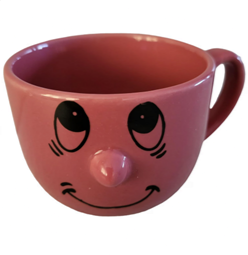
My mug looked just like this
Surely, to someone who doesn't have this issue, this will sound like unnecessary existential angst. But the thing is, it is the default expectation of my brain that once you establish something, it's established – it's there, solid ground. If that ground moves or disappears, then I struggle to walk, or even just stand still. I don't mind a last-minute change of plans – but I am devastated by any reminder of the passage of time. I just don't understand how people can bear it. Plus, time always just goes by too fast. Before you know it, what feels like yesterday is 10 years ago. It just terrifies me. Admittedly, part of the reason for this also has to do with my perpetual state of "being behind in life". Autistic Medium writer Jim Irion has written interesting things about chronophobia in autistic people in relation to those social dynamics.
My autobiographical memory – how I am able to remember my life – is not exactly normal, either. When it comes to change, I have come to realize that too much change, too quickly, affects how much I am able to remember. Too bad I have that sprinkle of ADHD, existential restlessness, or whatever it is, that constantly draws me towards new beginnings rather than stability. My twenties are a blur because I travelled a lot, and changed houses like every 6 months, as if I had been on the run from the police or something (no no, I am a law-abiding citizen, absolutely.) I changed a ridiculous amount of jobs and social groups (never really being fully part of any of them, yay), and changed my mind about career and life priorities an even more ridiculous amount of times. Unfortunately, this is another in-built feature of my brain.
On the other hand, repetition helps me solidifying my memories – I may not remember a place I visit once, but I will remember it much better if I visited even just twice or three times. Beyond that: I need repetition to stay sane. When too much happens, my brain genuinely just can't process it, and trouble begins. What happens, mainly, is that I will dissociate my way out of this world, with pretty serious consequences. My brain needs solid things to lean on – pillars that I can trust. I need to let context become background, and even let background become the boundaries of my world, until I can just take it for granted and forget about it, in order to have a world that I can function in. That is the best way I can describe it, I think. Change does not feel fluid to my brain, it feels like each and every time something solid has broken. It feels like a perpetual breaking of my being, in a way – a generalized sense of grief without a specific object. I know it sounds intense, and it is, so I need to minimize that. It is extremely limiting, I won't lie.
When it comes to physical environments in particular, post-burnout, I dread anything unfamiliar. I do not go to the closest pharmacy, the new music venue (when I go out, once every blue moon), the fastest train station – I go to the ones I already know. I absolutely hate visiting new parts of the city. I feel lost every time I go somewhere unfamiliar. I no longer want to travel. Well, I do, there are so many places I'd like to see, but I dread it. I dread even just getting to the airport. When it comes to culture, I have to avoid a certain kind of book or movie. I started reading The Overstory – a very good and quite autistic-coded book which tells human stories from the point of view of trees. To a tree, several generations of humans are a rapidly changing phenomenon that it sees in its lifetime. I had to stop reading it. It was giving me the dread. Similarly, I finished Wild Swans: Three daughters of China – a great book that tells the story of XXth century China through three generations of women – but that bird-eye perspective on history was pretty destabilising. I don't have personal ties to China, I am just that sensitive to it.
In hindsight, all my life I instinctively deployed small strategies to cope with impermanence and with how my memory works. I am not a hoarder, but I keep things. I kept my sister's set of foldable cutlery for camping (from her Boy Scouts youth), without using it a single time, for 10 years, through what I reckon must have been at least 10 changes of houses across different countries. My sister had thrown it away 10 years prior, but I saved it (then gave it back to her, she was astonished, it felt like an ancient archeological finding to both of us. I think she threw it.) I have small trinkets from places I visited, things that remind me that something has happened, and that make me feel like a part of that experience is still with me. Pictures I care about a lot. Without that, I would forget about a lot of things, and I would get that dread about the fact that it's gone. Nostalgia is definitely my biggest illness, but I can't help, truly.
It took me a long time to piece together that my difficulty with change is, in fact, one of the major drivers of my depression. The passage of time can be so painful to me that it can make me tempted to cut time short altogether. "The only thing that doesn't change is the fact that everything changes", the Buddhists say. "La vie est mouvement" ("Life is movement") says French rapper Keny Arkana (goddess of spiritual rap.) And it's so true. When we are alive, we are warm, because our molecules never stop vibrating, our heart never stops beating, movement is the essence of what makes life alive, and that is incredible. It just seems that my brain is fundamentally at odds with a basic fact of this world. There is that movie, The Legend of 1900, about a pianist that spent his entire life aboard the same ocean liner. He was found on the vessel as a baby, he never set foot on land, never left the vessel. He spent his entire life playing the piano on the ocean liner, and all he knows about the outside world and its music trends is from the passengers. At the end (spoiler), the ocean liner is no longer used, and it's scheduled to be scuttled, but 1900 (that is his name) refuses to leave the vessel, because the world is too big for his imagination, and he'd rather die there. I remember watching this movie as a child, and wondering if I would have liked a life like 1900, and feeling conflicted about it. I still do.
The world is too big – it makes me too curious and too overwhelmed at the same time. I need anchors, and I need freedom. Thinking about it – I could have stayed in the tiny village where I am from, never leave, and be 1900. There are pockets of the world where nothing changes. And yet, I didn't.
Ecuador Stories #4: Hungry for Cheeseburgers and the Fern Gully Experience
Stevie Lou Díaz
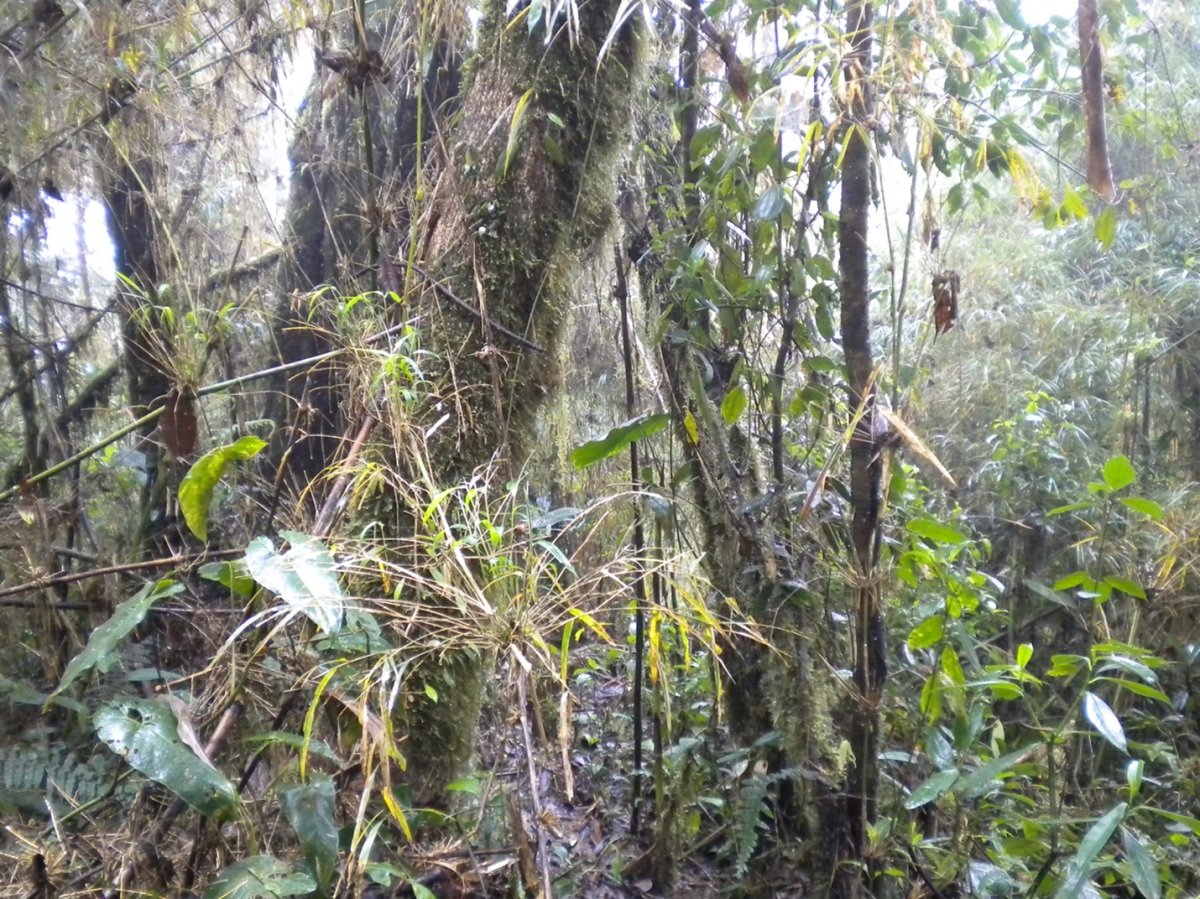
Photo by Stevie Lou Díaz
Fieldwork in the cloud forests was fun and difficult.
Being on the equator, the sun rose at 6 am and set at 6pm every day. As the name suggests, the clouds rolled in at sunset and you would literally be IN the clouds. Our cook started out making good food, but ended up slacking on trips to the market for supplies to feed us. Much of the food she did make was given to the children who would catch the bus to school in front of our house. Being just the 3 of us alone in the house, we didn't know we should have received more food, and we would not complain about kids getting fed more than us. We were hiking all day and living off of meager rations for a week or so. The lunches we packed each day consisted of pupusas and fruit. Dinner was salad with canned anchovies. I wanted a cheeseburger so bad. We actually thought about going to town to buy a chicken, but we always ended up eating in town and abandoning our plan. Notably, almost all the lunch specials in town were chicken and rice with a mango salsa. Thankfully, we had fresh squeezed tropical fruit juices everyday.
I managed to get blisters the size of silver dollars on the balls of my feet during the first week. I just kept going until my brain ignored the pain. Phoning home that week was not fun because it meant I had to hike about a mile or so to the local store to use their phone. If I remember correctly, bus rides cost 10- 25 cents depending on where you were going. International banks were few and far between and going to banks exposed you to pick pockets, which made covering each other's bus fares a big deal. We would negotiate down to the nickel what we owed each other during our weekend trips.
A SIDE DISCUSSION ON EVIDENCE OF LIFE AND DEATH: In 2010, the History Channel started airing Ancient Aliens while at the same time my biology classes taught the great Overkill Hypothesis to explain the extinction of North America's giant mammals. I became interested in the spread of humans to the Americas. While in college I would often distract myself from studying at the library by reading other (off-topic) scientific journals. I really liked reading the journal Quaternary, which includes a range of scientific fields discussing geological, environmental and human sciences. I found that this journal had many articles that published out-right trash talk between differing scientific stances. Finding the trash talk became a little game of mine.
I think humans arrived to many coastal points of the Americas in boats, and were NOT restricted to the Bering land bridge. And while I believe in parallel universes and the possibility of aliens, I resent people who accepted ancient architecture in the old world, and then see similar structures and technology in the new world and suddenly think aliens must have told them how to do it. As if the human experience could not be realized across the globe? Quaternary had some articles with good smack-talk about human migration.
I also enjoyed reading anything about how Central and South America had the most speciation (or biodiversity) over geological eras compared to North America. In class, we were taught that North America had more speciation. Scientists based this on fossil records being more prevalent in North America. But, one should consider survivorship bias. I was the annoying college student wearing a knitted frog hat raising her hand with the, "Yeah, but. . ." responses.
THE SURVIVORSHIP BIAS EXAMPLE:
Just because many fossils and human artifacts are showing up in North America does not automatically mean that there was more speciation and civilization in North America compared to South America where decay happens quickly, and the geological eras may have sustained environments with higher decay for longer periods than North America. There is a great book, The Lost City of Z, that talks about this. It's a good read for those that like scientific adventures. As I walked around the cloud forest without any field guides (shameful, I know!) I was amazed at every little microclimate of life and also death. I would peek into bromeliads, but then had to stop because sometimes very large insects would pop out and the bromeliads would fall apart with not much force. Each hike was overwhelming to the senses. Like Fern Gully, the network of life and death was very complex and highly responsive. During lunch, I was so happy to sit and soak in all the growth and decay rates that I spent countless hours imagining during school. The fossils were disappearing before our eyes! Like the twelve hours of day and twelve hours of night, the forest was a balancing act of unfathomable orders of magnitude. A few of our radio telemetry points (for tracking the Andean Bears if you need a reminder of why I was in Ecuador) went above the tree line, called the paramo. This reminded me of home, as it looked more like chaparral habitat. Going to the paramo was like coming up for air, only there was less air. . .because the elevation.
Poem: To Lose Me
Lauren Hackett
What a relief it must be
to lose me.
Twist your flesh
to hold back
the excitement.
Door clicks shut.
Shoulders relax.
The air is light,
sugar-smelling—
like mouths.
Birds swoop low
to win your attention.
Sidewalk strangers
call you by name,
tell you what you’ve
always wanted
their futures—
No one to pull in
to conversations.
No one whose behavior
but their cups overflow
in my absence.
to lose me.
Twist your flesh
to hold back
the excitement.
Door clicks shut.
Shoulders relax.
The air is light,
sugar-smelling—
what to do first?
The city regains color.
Flower buds open to youlike mouths.
Birds swoop low
to win your attention.
Sidewalk strangers
call you by name,
tell you what you’ve
always wanted
to hear.
Shining, untouched women
offer you their youths,their futures—
will you accept?
Laughter comes easy
at family gatherings.No one to pull in
to conversations.
No one whose behavior
demands explanation.
My name is not said
above a whisper,but their cups overflow
in my absence.
Poem: My Little Bird
Alice Krin
You say you’re not a writer —
but you write and write,
not books, maybe, but your own life.
Your words are aching to spill onto paper,
bursting out of your soul — into the world.
Not to be read,
but to be released.
Set free to fade away with the pages,
to live out their colors and scents,
to breathe in the essence of this world.
Even words long to live a life of their own.
And you — still doubting,
still searching for your place,
for your companion,
for that song to sing together at dawn.
You look at your fingers,
torn and raw,
your prints worn away —
hands that bite into themselves
trying to pull out the pain left by others.
Yet you sing.
You keep flying,
healing your wings with tears,
trusting the wind
as if it were your destiny.
Do you know what I love most about you?
At any moment, any second,
no matter where the sky carries you —
you can change your course.
Unlike the words in your journals,
you are free to choose.
You can fly.
And that is the greatest gift —
to know how to fly
and to sing your song
in any corner of the universe,
wherever the wind may take you.
You need nothing for that —
nothing but yourself.
Only your soul —
always whole,
always honest, clear, and bright.
And when it feels too hard,
listen to its melody —
it will lead you home.
Sing,
my little bird,
and spread your wings.
That’s what life is for —
to live,
to seek,
to keep searching.
It only means there’s a spark within you —
the kind that can give birth
to a dancing star.
But remember —
there is no star in this world
more precious
than you.
Falling In Love With Winter
Christina Donaldson
I came up with this poem while on a winter walk
in New York a few years ago.
I fell in love with winter
on a sunny afternoon.
She kissed me with her snowflakes
and embraced me with her breeze.
I fell in love with winter
on a sunny afternoon.
Her cold air took my breath away
and brought me to my knees.
Song: Little Island
Mia B.
Little Island
They say no man is an island
but every woman is
And from the deck where I am waiting
I see her blurred, the lens is dim
Some make their women out of seafoam
and build them castles in the air
My woman's frozen and she's fleeting
the bridge I'm building leads nowhere
And every woman has a secret
none of them know what it is
All they know is how to keep it
in that hole between their ribs
She brings clear liquor in a teacup
she writes the rules (they're all unfair)
But I will stay, I will stay and play my part
combing the seaweed from her wet, dark hair
And every woman has a secret
none of them know what it is
All they know is how to keep it
All they know is how to keep it
in that hole between their ribs
I went down to where the land ends
couldn't bring myself to swim
Time and tide may wait for no man
They are the weapons of all women
Humor: Anonymous autistic person commits arson following week of comments on their autism
An anonymous autistic person has reportedly set fire to the car of a massage therapist who told them that they couldn't possibly be autistic because they were able to maintain eye contact.
According to reports, the autistic person "finally lost it" after a whole week of people commenting on their autism. AWG Shares has obtained an exclusive interview with the person.
Speaking on a videocall without camera, the person said: "I came out as autistic this week and god knows everyone has opinions. Just yesterday, a colleague had told me that I can't be autistic because I look nothing like the only autistic person he knew, which is their cousin's daughter's best friend's brother, who can't talk. The day before, my new therapist had told me that he didn't think I could be autistic because 'I am so self-aware'. The postman on Monday noticed that I had received a letter from an autism charity, and he said 'Oh I'm so sorry about your kid. My niece has that too.' The mum of one of my kid's classmates told me to take vitamin D. Donald Trump said we should be forced to take fucking Leucovorin. My mother told me I am her special angel. My friend told me that I should get a second opinion, and not to rush to put 'labels on myself'. The Daily Mail said it's a trend. My doctor told me that he doesn't think I am autistic, so he denied the referral for a diagnostic evaluation. My work's HR told me that they couldn't give me accommodations without a diagnosis. But my doctor had denied me the referral, so how do I get a diagnosis? My uncle suggested I pray every day, and if it doesn't work, I get an exorcism. An online influencer said that autism doesn't exist, because it's all just 'trauma.' My sister said 'well, yeah, but you are not autistic autistic, are you. Maybe just a little bit.' My other sister said 'yeah well, I already knew, you've always been such a weirdo.' Not sure which one is better. Even my dog barked at me when I said the word 'autistic' while registering a voicemail! All of this in the space of a week. So I thought, 'okay, let me get a massage on Sunday'. To relax, I thought. I went to this 'inclusive massages' place. I thought 'great, it's safe here' so I made the mistake of telling them why I was there.
When the massage therapist told me that I couldn't be autistic because 'I could keep eye contact and her diagnosed autistic son couldn't', it was the last straw. I had taken all that I could take. A switch flipped in me, I don't know how this happened, but I suddenly transfigured into a monstrous creature dominated by rage. I tripled in size. I felt scales growing out of my skin. My eyes became wide and red, fuming horns sprouting from my head, recurved nails grew from my toes. I stomped on the massage bed with my new giant dragon foot and broke it in half at once. I squandered the speakers, and that annoying relaxing music finally stopped. I really wrecked havoc. The massage therapist looked at me terrified. I ran out of the beauty centre with big, heavy, steps, to scream outside. A monstrous, deep, non-human scream came out of my throat, reverberating over the roofs of the whole city:
"AAAAAAAAARRGGGGGHHHHHHH!!!" that's when my fury came out as fire from my mouth. I burnt the massage therapist's car with one, uninterrupted flame. I don't regret it. It was really satisfactory - it repaid me for the whole week of stress. More relaxing than a massage, really. I know it counts as arson, but I was transfigured. I was not myself, I was possessed by the fire of Frustration. The car was nothing more than a little hill of ashes when I left. On Monday I was back in the office in my human form, negotiating with HR to obtain the right to work from home."
Note: AWG Shares and the author of this piece do not endorse using arson as an answer to comments about your autism. If you have such thoughts, screaming in an empty natural space, punching a pillow, or producing art depicting monstrous themes, are all valid methods to express your justified frustration. Any resemblance to real events and/or to real persons is purely coincidental.
Bathrobe Comics: "Do Your Best!"
Sarah Jane Cody
First published on Jan 16, 2025, on the Bathrobe Gal website
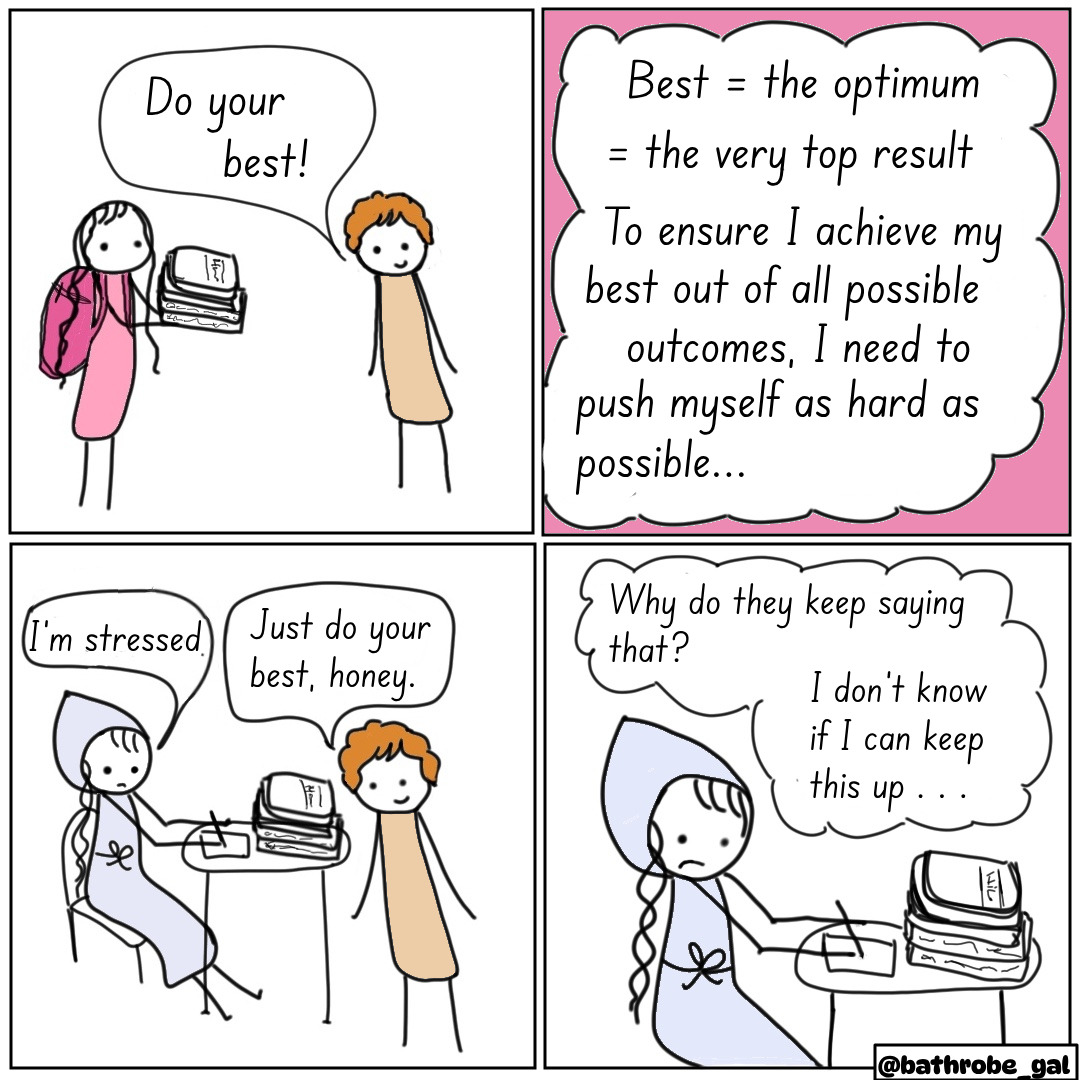
One of the ways I can be literal is especially when it comes to instructions.
Dr. Donna Henderson helpfully frames this autistic tendency as a “need for explicit context”. As a fiction writer, I understand and often love metaphors in reading, but the vagueness that constantly comes up in causal speech can be so confusing. As a very frightened kid trying to make sense of a bewildering word, I inadvertently created rigid rules out of a lot of things that my parents meant to be interpreted flexibly.
“Need for explicit context” not only helps explain me––it’s a helpful suggestion for what others can do to help their autistic loved ones.
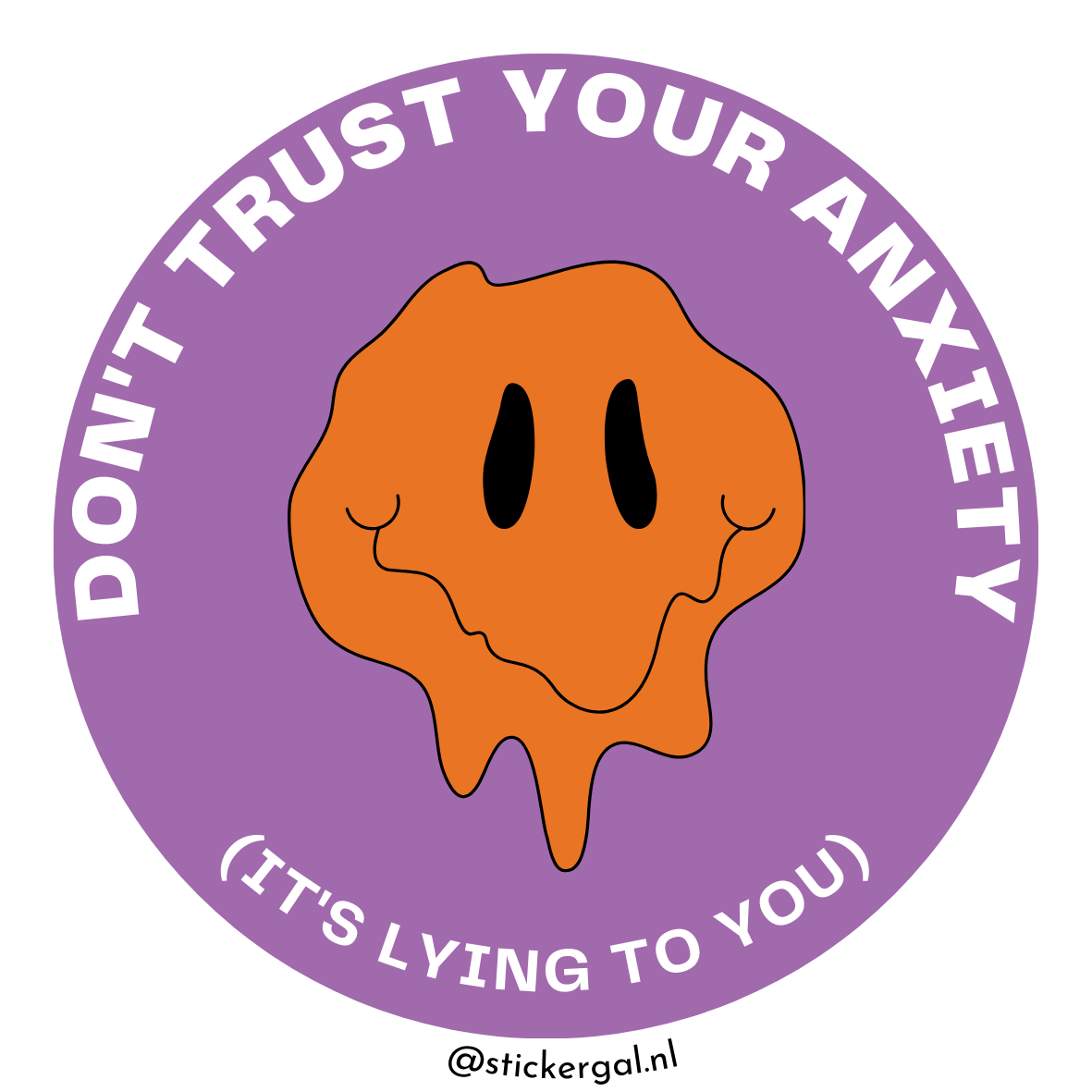
Sticker: Don't Trust Your Anxiety (It's Lying to You)
Elissa Fox