
June 2026

Contents
June 2026 • Vol. 2, Nr. 6
Editorial Dept.
Annie Mydla
Sol Iacob
Cover
by Sol Iacob
Annie Mydla
Sol Iacob
Cover
by Sol Iacob
by Annie Mydla
by Sol Iacob
by Alëna Korolëva
Essay
Reprint by The CVI Perspective
Essay
by Andrea
About Autistic Women's Group
Established 2021
AWG is an online support group for late-identified autistic women and all other members of marginalized genders.
The meeting format is designed to reduce the sensory, social, and executive function burdens that normally come with socializing. Our members are clinically-diagnosed, self-diagnosed, and questioning. AWG is volunteer-led and not associated with any other umbrella organization or company.
Please consider joining us on Zoom. Our member profile is inclusive. Meetings are always free and no registration is required. Members share by speaking or typing. We have many members who come just to listen. You never have to turn on you mic or camera if you don't want to. You don't have to come to every meeting, or stay the whole meeting, in order to be a full member. Disclosure of diagnosis/gender identity is welcome but never required for participation.
Click her to learn more about attending a meeting. You can also...
- See upcoming meeting topics
- Sign up for meeting reminders (scroll the homepage to find the signup form)
- Join the AWG subreddit for weekly meeting reminders
- Join our sibling meetings: the AWG Self-Esteem Group, Book Club and Connecting Hour, and Discord server
I hope you enjoy AWG Shares Magazine. And please do join us in a meeting sometime if you can.
Annie Mydla
Founder and facilitator, AWG
About the cover
Sol Iacob
This cover is an aerial photograph by Australian landscape photographer Mark Gray. I chose it because I like how nature is the best artist, and how similar the macro can look to the micro sometimes.
We are always in need of covers! Submit a cover, or an image that you would like to see on a cover, at https://autisticwomensgroup.com/submit
Essay
Nearshore: Reflections on Accessibility in a Sound Installation
Alëna Korolëva
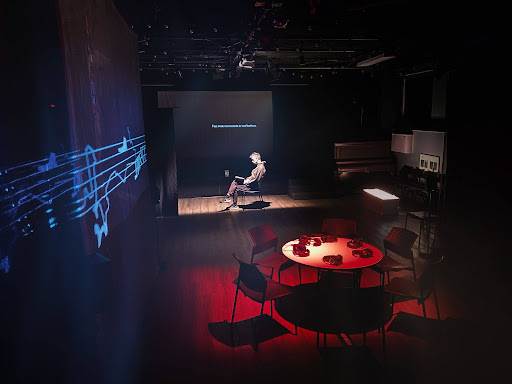
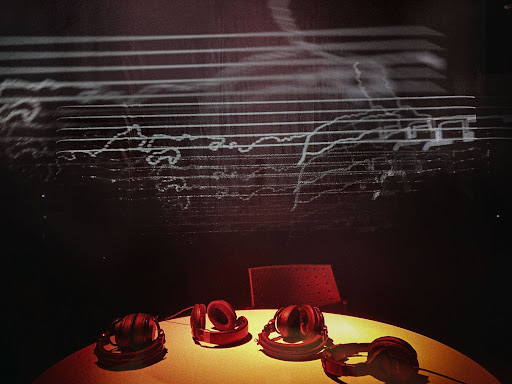
I work in the fields of sound art and acoustic ecology, and in April I presented my first solo sound installation, Nearshore. Organizing a two-day exhibition without a budget was challenging, especially while balancing ongoing health struggles. But it also became an opportunity to explore a question that has been increasingly important to me: what does accessibility in an art space actually mean for a neurodivergent audience?
You may find a description of the project on my website - https://alenakoroleva.com/NEARSHORE, but here I would like to focus on audience experiences.
I wanted to share this project in AWG Magazine because our group and the neurodivergent community in general has influenced the way I think about access and accommodation. While planning the event, I found myself reflecting on many of the experiences and needs people have shared within our community, and I tried to accommodate as many of them as possible.
This installation was a way to present my field recordings in a space. I arranged my collection of sounds (urban wildlife, sound markers of the place, nature elements etc) in a layered composition. Separate audio tracks are synchronized and designed to play simultaneously through four speakers and multiple open-back headphones. The transparent design of the headphones allowed sounds of the room to be heard in addition to the sound in the headphones. Tracks can be experienced independently or as complementary layers. A multilayered projection and translucent map booklet function as a non-linear visual score, while all sonic material is transcribed through captions to provide additional points of access.
In both composition and presentation, I aim to normalize diverse forms of attention and perception. I am interested in creating conditions where multiple modes of listening are welcomed. As someone whose attention and auditory processing is affected by multiple neurodevelopmental conditions, I prioritize experiences that offer choice and accommodation.
For example, placing an autistic person with a PDA profile (Persistent Drive for Autonomy) in a demanding situation of a gallery or a performance space can create an experience that feels overwhelming or even coercive. But any person regardless of their neurotype might find themselves limited by their environment and social expectations.
With Nearshore, I tried to give audiences options in how they engaged with the work. Those who are tired or easily overwhelmed can settle into the slow-paced, room-filling soundscape at moderate volume. Listeners seeking more intense input can zoom into details of field recordings on the headphones while still hearing the speakers. Transcriptions serve more than Deaf or hard‑of‑hearing audiences: they provide structure for people who process verbally or want to learn more about sources of sound. I also made sure the event started exactly on time by projecting a countdown on the screen beforehand. Clear signage throughout the building indicated where to go and where to find the washrooms.
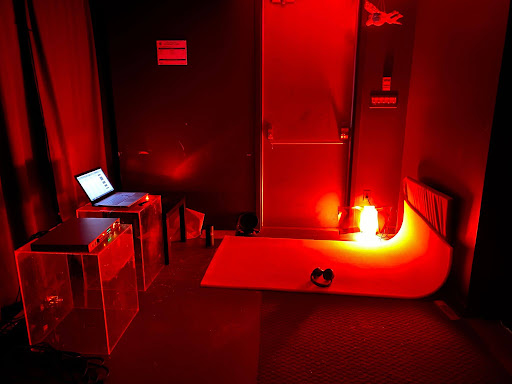
As a small additional accessibility measure, I placed signs in the washrooms asking visitors not to use the loud hand dryers and provided paper towels instead. The venue was wheelchair accessible, and I spent considerable time arranging the space to eliminate trip hazards—no small task given the number of cables involved. In the event announcements, I also asked attendees to refrain from wearing fragrances as an act of care for people with chemical sensitivities. I advertised it as animal friendly, and a couple of people came with well behaved dogs. I also tried to accommodate my own needs and created a little space backstage where I could spend time during the show.
Looking back, what interests me is not only what worked, but what didn't. Some visitors loved the dark room illuminated by warm-coloured lights, while one person found it difficult to navigate because they could not see well. We guided them through the space, but the experience revealed a limitation in my design choices. Because my budget was essentially non-existent, I could not provide a variety of seating options. Ideally, I would have included floor cushions of different sizes alongside standard chairs. Instead, only plastic chairs were available, and all headphones were concentrated around a central table. As a result, people tended to sit together while listening. I suspect this created a degree of social pressure, making it less obvious that visitors were free to move around or engage with the installation in different ways. Only a few people appeared to actively choose how much information they wanted to take in. Some commented that they were unsure where to direct their attention, while others enjoyed the choice between looking at the captions projected on the large screen and the translucent layered projections in another part of the room.
I am now planning to recreate the installation with these observations in mind. The next version will include a visual guide explaining how to navigate the space and outlining the different modes of engagement available. I also hope to have an attendant present to introduce the installation and answer questions. In addition, I would like to decentralize the listening experience by spreading out the headphone stations and rethinking the spatial arrangement of the speaker-based sound.Thank you for reading. If you are interested in questions of accessibility, I would love to hear your thoughts. You can tell me anonymously through this form using questions as a guide or by leaving some comments in an open space. It can be as little as one word: https://forms.gle/X8GWXoP6f8tsgxLRA .
Reprinted Essay
On CVI and Autism
Editor's note: This is a reprinted article from The CVI Perspective ( https://thecviperspective.wordpress.com/home/ ). The CVI Perspective is a blog for people with Cerebral Visual Impairment (CVI) to share about their direct lived experiences, in order to provide awareness of CVI from the perspective of those living with it. Cerebral Visual Impairment, as the name goes, is a form of visual impairment linked to how the brain processes the image, rather than an issue affecting the eyes. As such, CVI is a spectrum with multiple dimensions of visual struggle, and a fluctuating disability depending on context, energy levels, etc.
CVI is a generally underdiagnosed condition, and it overlap with autism in several ways. It is more common among autistic people, as well as being often misdiagnosed as autism, or potentially overshadowed by it. The text below is written by an autistic author with CVI.
On CVI and Autism
I’ve had a lot of people ask me in CVI spaces if I was misdiagnosed as autistic. I was diagnosed as autistic (or technically, Asperger’s when that was a separate category), but I find it to be an accurate diagnosis in my case.
Here are the reasons why I know that my autism isn’t a misdiagnosis. My sensory issues have always extended far beyond my CVI. I am extremely sound-, tactile-, and olfactory/gustatory-sensitive. I can often pinpoint exact subtle ingredients in dishes. When the US was testing blind people to add tactile features to money, I could also feel the layers of ink and the anti-counterfeit features that were designed to be undetectable to human touch. I was told I was the most sensitive tester they had. When I had my hearing screened, I maxed out the sensitivity of the machines. I wear loose clothing because I can’t tune out the sensation of fabric on my body.
I also have the social components. I got in a lot of trouble as a kid for flouting sociolinguistic norms that I didn’t understand were norms at the time. I spoke very directly and didn’t change how I spoke depending on my relationship to the person. It just wasn’t on my radar. Taking sociolinguistics courses in college taught me about phenomena like Politeness Theory and Grice’s Maxims, which helped me understand years of communication breakdowns, and also provided elegant solutions to these problems. For example, one of Grice’s maxims states that people will only give as much information as needed unless there is an ulterior motive (such as being sarcastic or lying). I had a habit of giving too much information when people asked me questions, and this finally explained why people would grow more and more suspicious as I tried hard and harder to prove I was telling the truth by sharing more details. I was violating this maxim unknowingly and they were judging me by this maxim unknowingly. I was operating by autistic norms, and they were interpreting them through neurotypical norms. And neither of us were aware cross-cultural communication was happening, so the misinterpretations continued and accumulated without awareness or opportunity for repair.
I also notice there is a higher prevalence of visual processing issues among people with autism. Quite a few of my Autistic friends have elements of CVI, even if they don’t have full-blown CVI. For example, a number of my sighted Autistic friends have face-blindness/prosopagnosia. Quite a few have topographical disorientation issues. There is clearly an overlap with being Autistic and having some degree of visual processing issues, even if it isn’t so severe to warrant a CVI diagnosis. In some there is total overlap. I know two Autistic adults who are functionally totally deaf-blind due to such severe combined CVI and CAPD that their retinas and cochleae are utterly useless to them. They rely fully on Braille and tactile sign language.
I know that there are many CVIers who are genuinely misdiagnosed as autistic. I know firsthand the pain and consequences of being mislabeled by the medical system, and the concrete intense suffering that can result. I spent years going to physical therapy that was damaging my joints because of a misdiagnosis, and feeling like I was being tortured every second of it. It was making me much more disabled. The correct diagnosis was necessary to get me connected with the right kind of physical therapy that is still painful and unpleasant in the moment, but nothing like before, and that I can tell maximizes my functionality.
It goes without saying there is a strong incentive not to confuse CVI for autism where there is no autism there. The stakes are high to get the diagnosis right, especially when you are trying to be guided to a treatment that will help alleviate any suffering-based aspects of disability. A lot of time, energy, effort, and money is on the line.
So the question becomes: how do we know if someone with CVI was appropriately diagnosed with autism, or misdiagnosed? What are some patterns laypeople can look out for in order to seek out the right specialists and access the right services?
I think one of the ways to tell is to look at patterns that don’t affect the visual system. Lack of eye contact and poor visual processing alone do not autism make. A lot of CVIers without autism also have auditory processing issues, so I wouldn’t lean on that to differentiate either.
There are many other signs of autism that go beyond visual or auditory processing. I have many of the gastrointestinal sensitivities that are common to a lot of autistics as well. I react to a lot of foods. There are also a lot of environmental triggers (like strong perfumes, mold, dust) that cause my body to react. My whole system is so sensitive that I can’t touch pharmaceuticals, not even OTC ones. My bodily immediately goes into either “eject mode” or “shutdown mode”. Even high-quality medical cannibis that was carefully selected has similarly triggered “eject mode”.
I have always had very specific and intense interests, another hallmark of autism. I was obsessed with physics, music, and languages as a kid. I still love these topics and could talk about them for hours.
Even though I am highly verbal most of the time, like many people with autism, I do lose language when extremely stressed, overwhelmed, or emotional. One time I lost language for a whole day after feeling the collective grief of an entire crowd because of a protest I attended honoring the victim of an unjust murder. All of these are examples of additional signs one can look for to help determine if someone with CVI is also autistic or not.
I think it’s really important for us to find the delicate balance–validating and seeing autism in a CVI person when it is there, and also validating and seeing when CVI is misdiagnosed as autism. We can learn to acknowledge the overlap, and also to acknowledge the differences, and we can continue to fine-tune our discernment, both as laypeople and as professionals.
Note: The CVI Perspective is currently open to submissions from people with CVI. Submissions can be sent to: thecviperspective@gmail.com
Want to promote your business, product, or service in AWG Shares? You can!
Promotions are free for everyone who fits our member profile.
Your business doesn't specifically have to be about autism,
but must be welcoming to women and non-cis people
(FTM/MTF trans, nonbinary, genderfluid, autigender, and more).
Email awg@autisticwomensgroup.com or use the submissions form and we'll set up your promotion for the closest upcoming issue.
Essay
I thought it was love but it was bottom-up processing
Andrea
https://medium.com/@Andrea355
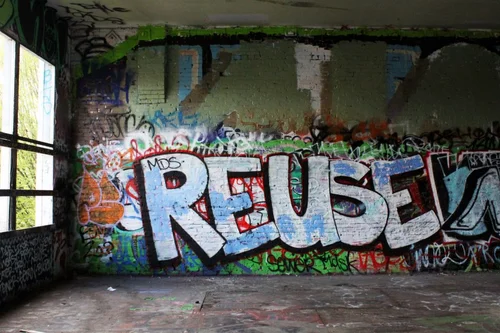
As a child, I had a whole drawer full of seashells, a whole drawer full of rubber balls, and a whole drawer full of waste scraps (but my parents still maintain there was "no sign" of autism in me, joke's on them). I never really decided to keep the scraps, it just happened – I liked them and I kept them. It was like a primal instinct for me. I gathered. And after I gathered, I repurposed. I am not a hoarder, I swear. But I still like to save objects from being thrown into the trash. Random pieces of broken things, useless plastic objects, unappealing screws. I have saved them from my flatmate's throwing wrath numerous times. Then from time to time, I go back to the scraps. I don't really decide that either, it just happens. I get the inspiration and I go and make some new object out of them.
Something about waste has always bothered me. I hate the idea of it, the awareness that materials will not actually disappear but just remain in the world as a problem (and probably travel to another country), and the ways I still end up contributing to it. I struggle living a wasteful life as much as I struggle living a linear one: it just clashes with who I am. And I love repurposed things. I have a little too much fun upcycling old furniture. One time, I was in Venice, Italy, and I walked into an ancient frescoed building repurposed as a supermarket. I thought it was extremely beautiful, and I realized that I have an irrational and excessive love of repurposed spaces. I would love to live in a former church one day. Though admittedly, that's also because I love the idea of filling a church with queerness.
Recontextualized things, generative contrast, but also the reassurance of knowing where something is coming from and where it is going, and that nothing is lost in the process – transformation as a form of change that doesn't destroy but recombines, all of this feels soothing to my mind. I thought I was just peculiar, but I now connect all this to having a bottom-up cognitive processing style. Bottom-up processing style is the cognitive style that demands to go deeper about things, learn their origin, the why, the process by which they came to life, in order to understand them or apply knowledge.
And that makes sense to me. To live without knowing how my food was produced, where my waste goes, why the medicine works, or what the concrete effects of my work are, feels like an extremely wrong lifestyle to me. It makes me feel ungrounded, out of touch, like I am floating on the world instead of fully living it. But of course one can't know everything, make all their products, or grow all their food. It's too much. Traditionally, these were also collective activities, not just individual. I'm not unreasonable and I like to have some time left to actually do something else. Yet that more circular lifestyle is what feels right to me. Perhaps a more simple life. Something different from the chopped up reality of Western capitalism.
It is always a bit humbling to find out that what you thought of as a personality trait, or unique preference of yours is, in fact, a reflection of autism. But then I suppose everything of me is a reflection of autism? ...but I don't think I want to go there. What I really want to do is watch a documentary about the production of rubber. Just, you know, to know how it's made.