
September 2026
Contents
September 2026 • Vol. 2, Nr. 8
Editorial Dept.
Annie Mydla
Sol Iacob
Annie Mydla
Sol Iacob
Hannuh Frings
April Rose Burnette
Cover
by April Rose Burnette
Cover
by April Rose Burnette
by Annie Mydla
by April Rose Burnette
Poetry
by Autumn L Shears
Essay
Grieving My Diagnosis
by Nanny Goat
Grieving My Diagnosis
by Nanny Goat
Promotion
by Heather Cook of Autism Chrysalis
About Autistic Women's Group
Established 2021
AWG is an online support group for late-identified autistic women and all other members of marginalized genders.
The meeting format is designed to reduce the sensory, social, and executive function burdens that normally come with socializing. Our members are clinically-diagnosed, self-diagnosed, and questioning. AWG is volunteer-led and not associated with any other umbrella organization or company.
Please consider joining us on Zoom. Our member profile is inclusive. Meetings are always free and no registration is required. Members share by speaking or typing. We have many members who come just to listen. You never have to turn on you mic or camera if you don't want to. You don't have to come to every meeting, or stay the whole meeting, in order to be a full member. Disclosure of diagnosis/gender identity is welcome but never required for participation.
Click her to learn more about attending a meeting. You can also...
- See upcoming meeting topics
- Sign up for meeting reminders (scroll the homepage to find the signup form)
- Join the AWG subreddit for weekly meeting reminders
- Join our sibling meetings: the AWG Self-Esteem Group, Book Club and Connecting Hour, and Discord server
I hope you enjoy AWG Shares Magazine. And please do join us in a meeting sometime if you can.
Annie Mydla
Founder and facilitator, AWG
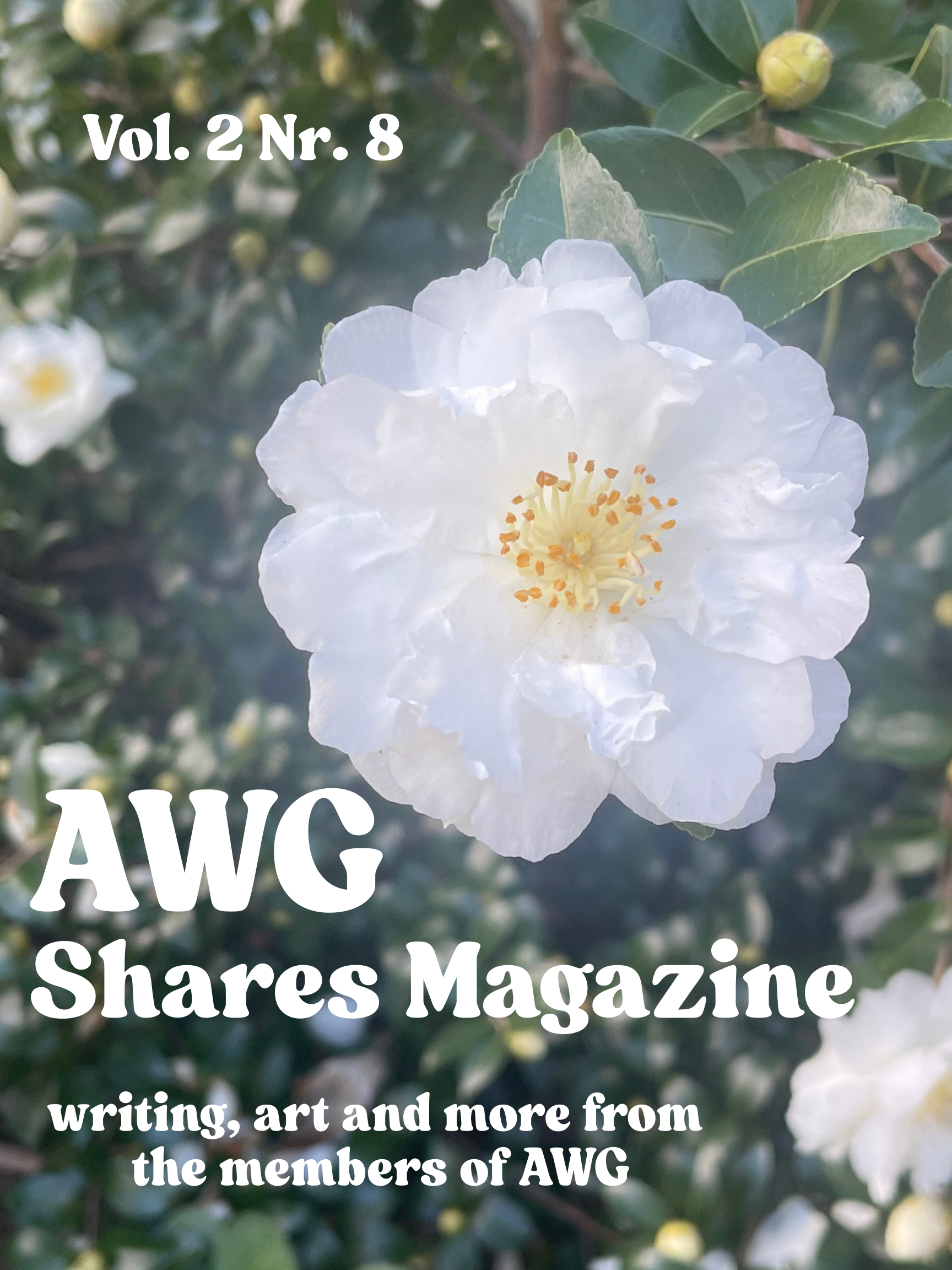
About the Cover
by April Rose Burnette
This cover is a photograph I took of a flower in my yard. Living in the southeastern United States (we just call it "The South"), I'm not really used to cold temperatures because it is usually hot as Hades. Our winters are absurdly mild and most (if not all) of fall/autumn is nearly as hot as summer, but in November of 2025, our temperatures reached historic lows. An Arctic blast caused freezes that broke records as far back as 1926 and 1950. Even though I was grateful that I wasn't any further north where there were dangerous levels of snow, I was miserable. I had never experienced temperatures that cold at home, but this flower seemed to be flourishing. I remember thinking that if this flower could thrive in the cold, I could at least survive it. Trite as it may be, that flower changed my perspective and I did, indeed, survive.
We are always in need of covers! Submit a cover, or an image that you would like to see on a cover, at https://autisticwomensgroup.com/submit
Poetry
Autistic and Lethargic
By Autumn L Shears
When most support comes from within
But will always be numbingly inconsistent
A will that metamorphizes into broken resolves
And bouts of surface level contentment and go-getting
Yet habitualness, familiarity, and the desperate urgent need to cope
Make an arresting reemergence to the forefront
It becomes a long stint of decoding insanity
Essay
Grieving My Diagnosis
By Nanny Goat
Part 1: Getting Diagnosed
The night before my final session with Dr. T, I started to talk myself into accepting that I would not receive a diagnosis for autism or ADHD. I had spent 20 hours with her, undergoing a series of cognitive tests and interviews, on top of numerous questionnaires that I filled out in advance of our sessions. I had waited on her waitlist for 8 months to be seen because she had been referred to me by a therapist I trusted, and I didn’t want to put my diagnosis into the hands of just anyone. If I got a diagnosis, I wanted it to be real. I wanted to believe it. I had already spent the last 2 and a half years self-examining, reading books, talking to people, and watching endless Instagram reels to understand if what I was experiencing was explained by ADHD, Autism, or both.
In my own head, I could make a case for yes, no, and sort of. And I did, often several times a day, flop around in that uncertainty.
So, when I lay down in bed that night, anticipating my 9 am appointment with her the next day, I wanted to reassure myself. I knew that I would be disappointed if there was no diagnosis, that it would mean that my hunches were wrong, and also that there was no really good reason for what I felt. That it was just life, or just me, and I was going to have to get over it. So I self-talked: she’s probably going to say there are some indicators, but they are not strong enough for a diagnosis, and since there is no obvious sign of harm (e.g., a successful career, an intact family), I do not meet the medical criteria. It’s okay. Maybe I have just a “touch” of autism, or maybe I’m just a little ADHD. It doesn’t matter. I’ll be fine. Maybe I’ll see if my OBGYN can increase the dosage of my hormone replacement therapy. Maybe that’s all I need.
I arrived at her office after an hour and twenty minutes drive. Did I mention that I picked a Doctor who lived 80 minutes from me, despite living in the Bay Area, where there are therapists and psychiatrists on every corner? As I said, I wanted the diagnosis to be Bona Fide. I sat down on the couch in her office, full to the brim with fidget toys, used to her ritual of inquiring whether the lighting suited me, the temperature, the presence of her dog. I appreciated these questions. I understood that she asked them to make her patients comfortable and to help train us to ask to be made comfortable. I could feel my nervous system settle as she opened her folder.
Oddly, Dr. T always started with small talk. Even though she treats people with autism, even though I had said several times that small talk does nothing for me. Every time she did it, I wondered, "Is this part of the diagnostic? Should I play the part of a normal person and engage in this conversation about kids and vacation, or should I play the part of a fully autistic woman and stare at her balefully?” I landed somewhere in between—short answers, small questions, over in a few minutes.
She asked me if I was up for one more diagnostic test. Honestly, I wasn’t. But, of course, I said, “Sure, if that will help you.” Anything for the cause to get a diagnosis that was 100% bulletproof.
This final diagnostic involved me looking at drawings of people in a scene and describing what was happening and how they were feeling. I sighed. I knew how to do this. It was easy. I talked about the 3 kids next to the chalkboard: one embarrassed, the other mocking, and the third concerned. I talked about the mother holding her child lovingly and the child in distress. I went through two more, then she put the placards down.
“Here’s the thing,” she said. “When I prompt you to think about people’s emotions, you can do it at a sophisticated level. But do you remember the exercise we did last week where you narrated that book of pictures?” Of course I did. “In that exercise, I did not prompt you specifically to talk about people’s feelings, and you didn’t. You narrated the book for close to 10 minutes, with rich detailing about scenery and plot and the adventure, but not once did you mention anything about what one of the characters might be feeling.”
Huh. Thunk. Mic drop.
I’m not sure exactly what she said next; it’s a little fuzzy, but I do know that she talked for another half an hour about vague things, context, the challenges of diagnosing women of my age. At 10:05, I interrupted her. I felt I had permission because of the context of why I was here. “I’m sorry, Dr. T. This is all interesting, but I have reached the limit of what I can handle in terms of waiting for the answer. Did you end up with a diagnosis?” I felt proud of myself for using such effective self-advocacy language.
She seemed surprised by my question, sat back in her chair, and laughed a little. “Right. Yes. You have Autism and you have ADHD. Both.”
I wish I could say that I let that sink in, but I did not. Without missing a beat, I asked the question I most needed answered: “Are you sure?”
Certainty feels so important, even now, even after doing all the reading I’ve done. Even after expanding my understanding to realize how little we know about brain complexity. Even, even, even. I want certainty. So much of my life has been me experiencing something, thinking something, feeling something and then looking around and saying, “Did anybody else get that?” Can anyone else validate that my reality is, in fact, the reality? That there is, in fact, a reality to which I can cling. So, I insisted, “Are you sure, Dr. T?”
Oh yes, she responded. No question.
Prove it, I said. Well, I didn’t actually say that. That would have been quite aggressive. What I said was, “Can you walk me through how you reached that conclusion and show me how you convinced yourself?” We spent the next two hours with her painstakingly walking me through each of the diagnostic criteria for Autism, each of the tests she had performed, how I had scored, and how she had interpreted the score. At noon, our appointment time was over, and I said, again without missing a beat, “What about the ADHD?”
We scheduled a follow-up session for two days later so she could walk me through the same process for the ADHD diagnosis. We scheduled the Zoom for two hours. We stayed on for three. She is, I see clearly, well-suited to her chosen field. I’m not sure how many psychologists in her position would have been so patient with me as I asked detailed questions about every diagnostic test and its interpretation. And she did her best to keep it structured for me. We went top-down from the DSM criteria and bottom-up from the tests. There was no clean way to do it, so we flip-flopped through it. It was exhausting, and frustrating, and satisfying, and, by the end, completely overwhelming.
Part 2: The Aftermath
I emerged from the Zoom call, which I had held in my small office at the back of my house, and wandered to the light-filled living room at the front. My adult daughter happened to be visiting and was sitting on one of the couches. My husband was in the kitchen, talking to both of us. I waited for a lull in their conversation. There was no way I could join in; I couldn’t even make out the words they were saying; it was all fuzzy.
“Well, it’s a yes. A yes on both,” I blurted. I had already told my husband when I had returned from my first half of the debrief session a couple of days earlier, but I hadn’t shared it with my daughter yet. “It’s really interesting,” I started to say, “On one of the tests, I score at the top of the charts on capability across almost every dimension, but then there are these very specific dimensions where I score well below average. It’s very spiky.”
They were both curious and supportive, and they asked me questions. I answered the first few, and then I got completely muddled. Despite spending 6 hours with Dr. T and taking copious notes on every detail she shared, I couldn’t explain why the test results led to the diagnosis. I was stumped. I could feel tears welling in my eyes. “I don’t really know,” I finally said. “It’s all overwhelming.” I should say that, in my normal state, I would have kept talking, thinking, analyzing, maybe even pulling out my phone to Google something to answer the questions, defend the diagnosis and understand it all a little better. But, in that moment, I didn’t do any of those things. I just surrendered to the feelings that overtook me. I felt suddenly so sad. Not that my family didn’t believe me. My daughter responded quickly, saying she understood why I was overwhelmed, to reassure me. I felt really supported by her in that moment. And my husband was already convinced; I knew I didn’t need to convince him any further. But me, little me. I felt sorry for little me. I felt the overwhelming presence of all my younger mes and how much we had struggled to fit in, how confusing it had all been, how much we wanted to be liked and loved, how convinced we were that if we tried just a little harder, learned one more skill, that everyone would like us, that we would be accepted, included, loved, believed.
People talk about waves of grief overtaking them, and I finally understood what that meant. I felt as though I were standing still, alone, and a wave of emotion pushed right through my heart. If I had been standing, I would have swayed; the feeling was palpable.
I sat back on the couch and closed my eyes. I let the wave come. I didn’t even have to feed it. I didn’t have to think of all the moments I had been hurt. Those scenes would come, have been coming, later. No scenes in my head, no narrative, just the feeling of sadness. A deep well, a heavy pulling on my heart.
Scenes come up on me out of the blue, usually completely unassociated with whatever is actually happening, and they take me down with a sudden ferocity. One moment I am looking at vegetables at the grocery store; the next, I am remembering the boy who told me, after a month of backpacking together, that he was sorry he hadn’t been nicer to me, sorry he hadn’t followed me when it was my turn to lead. He hadn’t intended to be mean. He was probably a nice boy, not the first nice boy who simply rejected me out of hand, refused to listen, sensed the oddity and worked to expel me from the group. I can see that younger me so clearly: dirt-streaked face, chiseled features, hopeful. I had been so strong back then. My instructor gave me a book, The Tao of Leadership, and I was convinced that if I studied, if I worked hard enough, I could learn how to get boys like this to let me lead.
Sometimes, anger comes up alongside the sad. Anger at the system that failed me, anger at my parents who were blind to my struggles, anger at the hordes of human beings who instinctively herd together and who, at every single point in my life, have made it clear that there is something about me that is a little bit different. Something that needs to be changed if I am to be accepted. A recruiter I met once at a coffee shop more than a decade ago told me after 40 minutes of conversation, “There’s something very specific about you.” I was taken aback. It wasn’t an insult, exactly. It certainly wasn’t a compliment. This man, an expert at sizing up talent, had simply noticed me. He’d made his observation, peered through whatever act I had been putting on and delivered his verdict. “Specific.” It’s not the worst thing to be called. So why do I remember it, even now?
I should also acknowledge that I feel relieved. The near-constant mental debate, “Am I? Am I not?” has been eliminated. The question is answered. So much about me is now explained, so much common ground with a different set of people. My husband found me a group for Autistic Women, and I attend their weekly Zoom meetings. I’ve raised my virtual hand and participated in the 3-minute sharing process each week, and every time I do it, I feel lighter. I feel seen, finally. While I ramble on during my allotted 3 minutes, a flotilla of heart emojis and 100s bubble up through the Zoom. This group of people get it; they relate. What I am saying is not crazy, not weird. It’s actually normal. I am NORMAL with this group of people. I can’t even attempt to express what a relief it is to feel normal.
In my day-to-day life, I’ve stopped asking, “Is this normal?” I already know the answer. Usually it’s not normal. More importantly, it doesn’t fucking matter.
Excuse the F-bomb. As an aside, I do like to curse, and apparently that is something common to autistic people. I intend to take that one to the bank, baby! No more shame for my potty mouth.
I guess the biggest relief from the diagnosis is that I am starting to ask for help. I asked my GP if I could try Adderall to help improve my focus. She wouldn’t give it to me, but she referred me to a psychiatrist. Initially, I felt extraordinarily frustrated by this gatekeeping. I have a diagnosis. I paid a crazy amount of money to undergo a most thorough evaluation process, and I still can’t get the medication I need? But it turns out my GP did me a favor: the psychiatrist she referred me to is amazing. I’ve seen her only twice, but she validated my diagnoses, provided me with experience-based recommendations about the medicine, spoke to me as if I were completely normal (which, I remind myself, doesn’t fucking matter!), and she gave me hope. Hope that I can be seen, accepted and loved and that I can seek support when I need it.
On a more day-to-day basis, I have become so much more accepting of who I am, what I say, how I feel. It’s a journey blah blah blah, but something in me has shifted. When I feel hurt or sad, I don’t hide it. When I am being dismissed or treated poorly, I advocate for myself without blaming the other person. And the compassion I am feeling for myself is filtering out into the other people in my life.
I listen to my dad talk endlessly about his latest project, and I remind myself that oversharing is an autistic person’s love language. I used to feel so alone when he talked at me without seeming to care if I was interested or asking about me. Now, I actually feel loved. He loves me. He trusts me. That’s why he is info-dumping on me.
I admit that I have diagnosed everyone in my family with something, and I know that is not totally kosher to do. But I am holding it lightly. They may have it. They may not. Whatever the case, I have so many new and different ways of understanding the people in my life.
And I am starting to feel less alone.
So that’s probably the biggest outcome. Less alone.
Want to promote your business, product, or service in AWG Shares? You can!
Promotions are free for everyone who fits our member profile.
Your business doesn't specifically have to be about autism,
but must be welcoming to women and non-cis people
(FTM/MTF trans, nonbinary, genderfluid, autigender, and more).
Email awg@autisticwomensgroup.com or use the submissions form and we'll set up your promotion for the closest upcoming issue.
Business Promotion
Workshop Recording
Autistic Burnout Explained:
What It Is, Why It Happens, and What Actually Helps
By Heather Cook of Autism Chrysalis
In July, I just gave a free workshop on autistic burnout.
Most people don't understand autistic burnout. Here's an explanation of what it is for later-identified Autistic and AuDHD adults, and for the family, friends, partners, therapists, doctors, and employers trying to support them.
Explaining Burnout
Most people in your life don’t understand autistic burnout: what it is, why it happens, or what actually helps. This is the explanation you can hand to family, clinicians, employers, or anyone who wants to support you but doesn’t know how. And if you’re Autistic or AuDHD yourself, it’s a way to understand what you’re going through, and to know it’s not just you.
In this workshop I explain:
- What autistic burnout is, and how it’s different from depression and ordinary burnout
- Why it happens: the mismatch between an autistic nervous system and a world not built for it
- Masking, sensory load, and the invisible costs that never show up on a to-do list
- What burnout actually feels like from the inside
- Why recovery takes months or years, not days
- What makes it worse: chronic illness, other disabilities, perimenopause and menopause
- The common things people try that don’t work, and why
- What genuine recovery takes, and the five areas of recovery work
- How to actually help someone in burnout, and what backfires
- What recovery looks like, and what’s possible on the other side
This workshop is geared towards later-identified Autistic and AuDHD adults, and for the family, friends, partners, therapists, doctors, and employers trying to support them. This space is inclusive, and the presenter is likewise AuDHD.
Click here to access the recording of the workshop hosted by Heather Cook of Autism Chrysalis on 25 July, 2026.
Click here for a Free Autistic Burnout Explainer:
When you don't have the energy or the words to explain autistic burnout, this free guide does the explaining for you.
This is a short, plain-language PDF you can hand to family, a partner, friends, doctors, therapists, or an employer, so they can understand what you're going through without you having to find the words.
Visual Art
MAGM
By La Chloësque
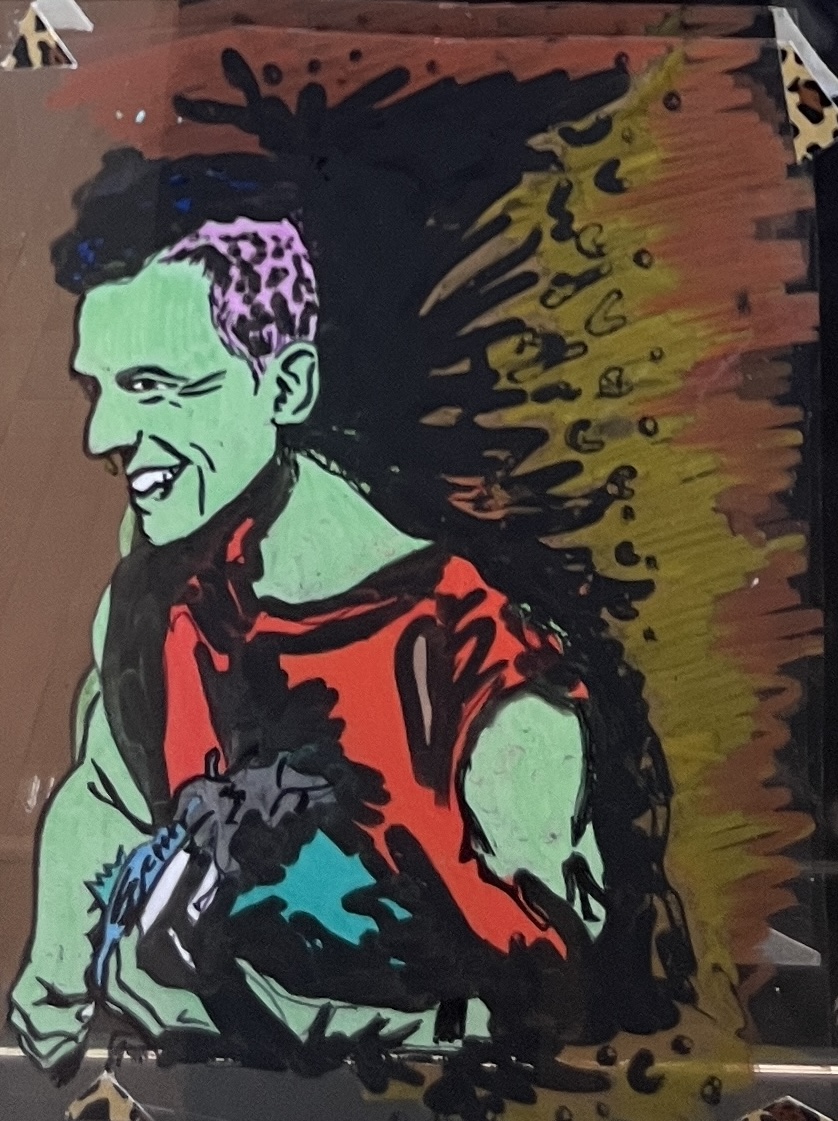
This is ... punkAF. limerance (light). full circle joy.
(c) 2026. Acrylic paint pens on acetate, duct tape.
Image description: Half-body drawing of a punk musician playing guitar and smiling broadly. Leopard pattern on sides of head and on duct tape triangles in corners, with abstracted leopard pattern in background. This picture represents the joy of music, self-expression, creative outlets, and revisiting the past with newfound joy appreciation.